
Skin boosters · Myeongdong, Seoul
Skin boosters Myeongdong Seoul: better skin quality, not a different face.
Micro-injections of hyaluronic acid, polynucleotides or collagen stimulators that improve hydration, texture and elasticity without changing your features. Choose with a doctor at RE:BERRY Myeongdong, two minutes from Myeongdong Station Exit 8.
Medically reviewed by Dr. Seung-Jae Baek, Chief Medical Director (licence No. 143338) · Updated 8 October 2026
Quick answer · What is Skin Boosters?
Skin boosters are injectable treatments that place small amounts of active ingredients, such as non-cross-linked hyaluronic acid, polynucleotides (PN/PDRN) or collagen stimulators, into the dermis. They improve hydration, fine lines, texture and elasticity rather than adding volume. A session typically takes 20–40 minutes including numbing, with small bumps or redness for one to three days. Most boosters work best as a course of 2–3 sessions.
- Session
- 20–40 min
- Downtime
- Small bumps 1–3 days
- Results
- Build over 2–8 weeks
- Course
- Usually 2–3 sessions
How it works
Different ingredients for hydration, repair or firmness
Hyaluronic acid boosters such as Skinvive draw water into the skin for a dewy look. Polynucleotide boosters such as Rejuran and PDRN support skin repair and thickness, while collagen stimulators such as Juvelook encourage new collagen over weeks. The doctor chooses by your main concern and how much downtime you can have.
-
Skin assessment
Your doctor checks hydration, texture and laxity and recommends the booster, or combination, that fits your goals.
-
Numbing & injection
Numbing cream is applied, then the booster is placed in tiny, evenly spaced amounts by hand or with an injector device.
-
Results build
Small bumps settle within days. Skin quality improves gradually over the following weeks, especially across a course.

Before & after
Smoother, more hydrated, healthier-looking skin
Most patients notice a softer texture, fewer fine dehydration lines and a healthier glow, with the change building gradually over a course rather than overnight.
Photos published with patient consent. Results vary between individuals and are not a guarantee of outcome.
A good fit if you…
- Have dry, dull or tired-looking skin
- Want to soften fine lines and enlarged pores
- Prefer natural improvement without changing your face shape
- Want a treatment that pairs well with lasers or lifting
Talk to your doctor first if you…
- Are pregnant or breastfeeding
- Have an active skin infection, acne flare or cold sore
- Take blood thinners or bruise very easily
- Have an allergy to fish-derived products or any booster ingredient
Compare options
Compare skin boosters options
| Treatment | How it works | Session | Downtime |
|---|---|---|---|
| Rejuran Healer | Polynucleotide (PN) injections | 45–60 min | Small bumps, 1–2 days |
| Juvelook Volume | PDLLA + HA collagen stimulator | 30–45 min | Minor swelling 2–5 days |
| Skinvive | Hyaluronic acid microdroplets | 10–25 min | Small marks 1–2 days |
| Exosome Therapy | Exosome growth-factor delivery | 40–60 min | Redness, hours to 1 day |
| PDRN Injection | PDRN regenerative injections | 30–45 min | Mild redness for hours |
Many patients combine treatments in one visit. Your doctor recommends a plan after examining your skin. See the full price list.
Your visit
From first message to flight home
-
Message us
Send your concern and travel dates on WhatsApp (+82-10-5719-2084), LINE or WeChat. A coordinator replies in English, Chinese, Japanese or Spanish.
-
Free doctor consultation
Skin analysis and photos, then a doctor confirms whether Skin Boosters suits you. You get the plan and price in writing first.
-
Same-day treatment
Most skin booster visits take 20–40 minutes in a private room including numbing; small bumps usually settle within a day or two. Written aftercare in your language, plus WhatsApp follow-up once you are home.
Who reviewed this page
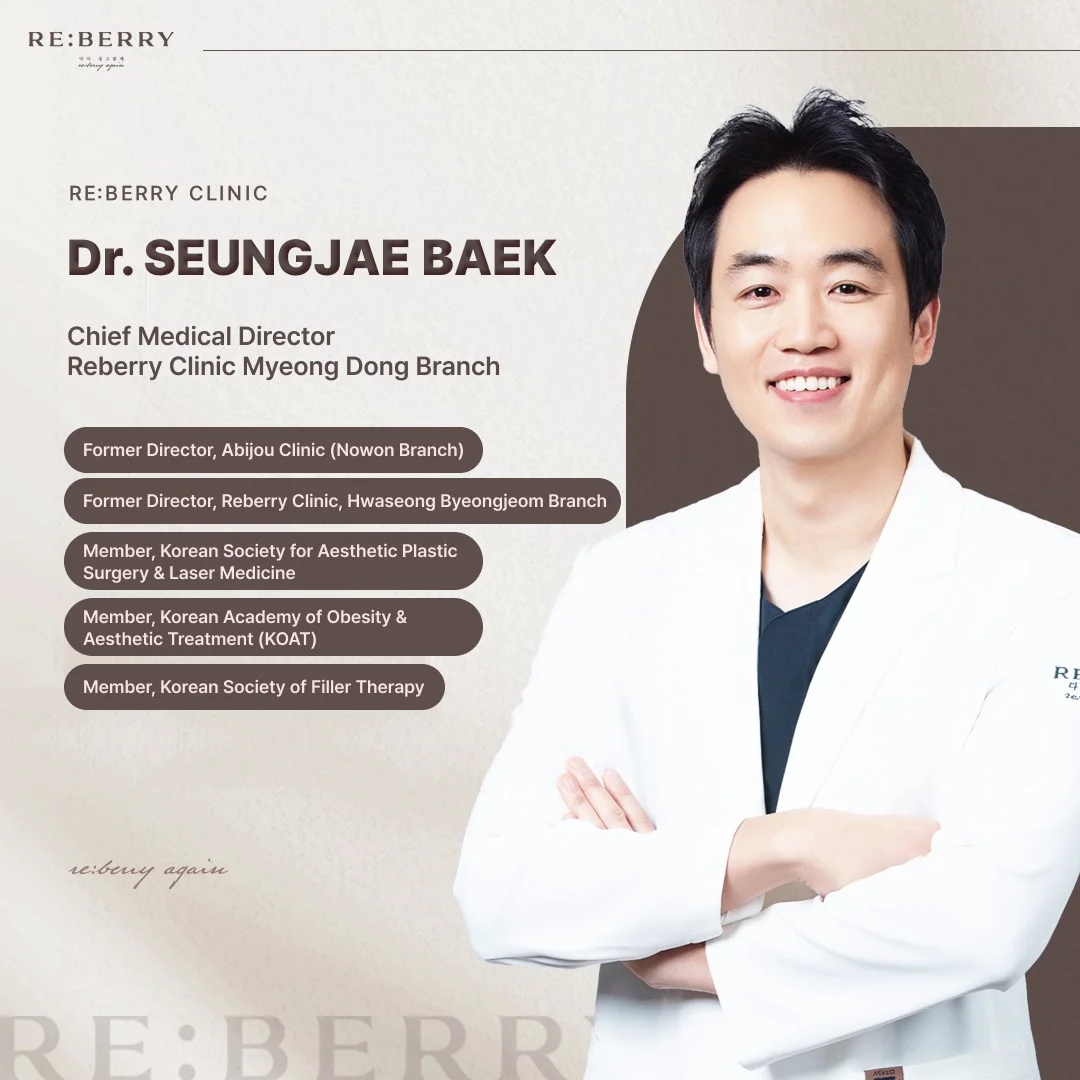
Dr. Seung-Jae Baek
Chief Medical Director · Korean medical licence No. 143338
JUVELOOK Meister & Speaker and Revinas Key Opinion Leader. Member of the Aesthetic Surgery & Laser Society (ASLS Korea), the Korean Academy of Obesity & Aesthetic Treatment (KOAT) and the Korea Filler Education and Research Academy. RE:BERRY Myeongdong is a KHIDI-registered foreign patient medical institution (Reg. No. M-2025-01-08-8519).
FAQ
Skin Boosters questions we hear every day
Which skin booster is best for me?
For hydration and glow, hyaluronic acid boosters suit most people; for thin or damaged skin, polynucleotides such as Rejuran are often preferred. Your doctor recommends one based on your skin.
Do skin booster injections hurt?
Numbing cream is applied first, so most patients feel only light pricking. Some boosters, such as Rejuran, sting a little more.
How many sessions do I need?
Most boosters work best as a course of two to three sessions spaced two to four weeks apart, followed by occasional maintenance.
Is there downtime after a skin booster?
Small bumps or redness usually settle within one to three days, and small bruises are possible. Most patients go out the same day.
Can I combine a skin booster with laser or lifting?
Yes. Boosters are often combined with toning lasers or lifting devices for tone, texture and firmness. Your doctor plans the order and timing.
How much does a skin booster cost in Myeongdong?
Price depends on the product, area and number of sessions. The same price list applies to every nationality and is given to you in writing before treatment. See our Rejuran and skin booster price list.
Related treatments & guides
Not sure which skin booster you need? Ask a doctor first.
58, Myeongdong 10-gil, Jung-gu, Seoul · 2 min from Myeongdong Station Exit 8 · Open daily, weekdays 10:30–20:00, weekends 10:30–19:00.
General information, not medical advice. Suitability for any treatment is decided at consultation.